The Siege of Osaka, fought in two distinct campaigns—the Winter Campaign of 1614 and the Summer Campaign of 1615—stands as the final monumental battle of Japan’s Sengoku period. It was here at Osaka Castle, the most formidable fortress of the age, that Toyotomi Hideyori and the ronin forces led by Sanada Yukimura—hailed as “the greatest warrior in Japan”—clashed with Tokugawa Ieyasu’s overwhelming army of nearly 200,000 troops. From the political intrigue of the Hoko-ji Bell Incident orchestrated by Ieyasu and the desperate defense of the Sanada Maru during the Winter Campaign, to the treacherous peace treaty and Yukimura’s legendary final charge against Ieyasu’s headquarters in the Summer Campaign. This article provides a comprehensive overview of this pivotal turning point in history, exploring the tragic end of the Toyotomi clan and the definitive conclusion of the Sengoku period.
The Siege of Osaka: The Last Stand of the Toyotomi
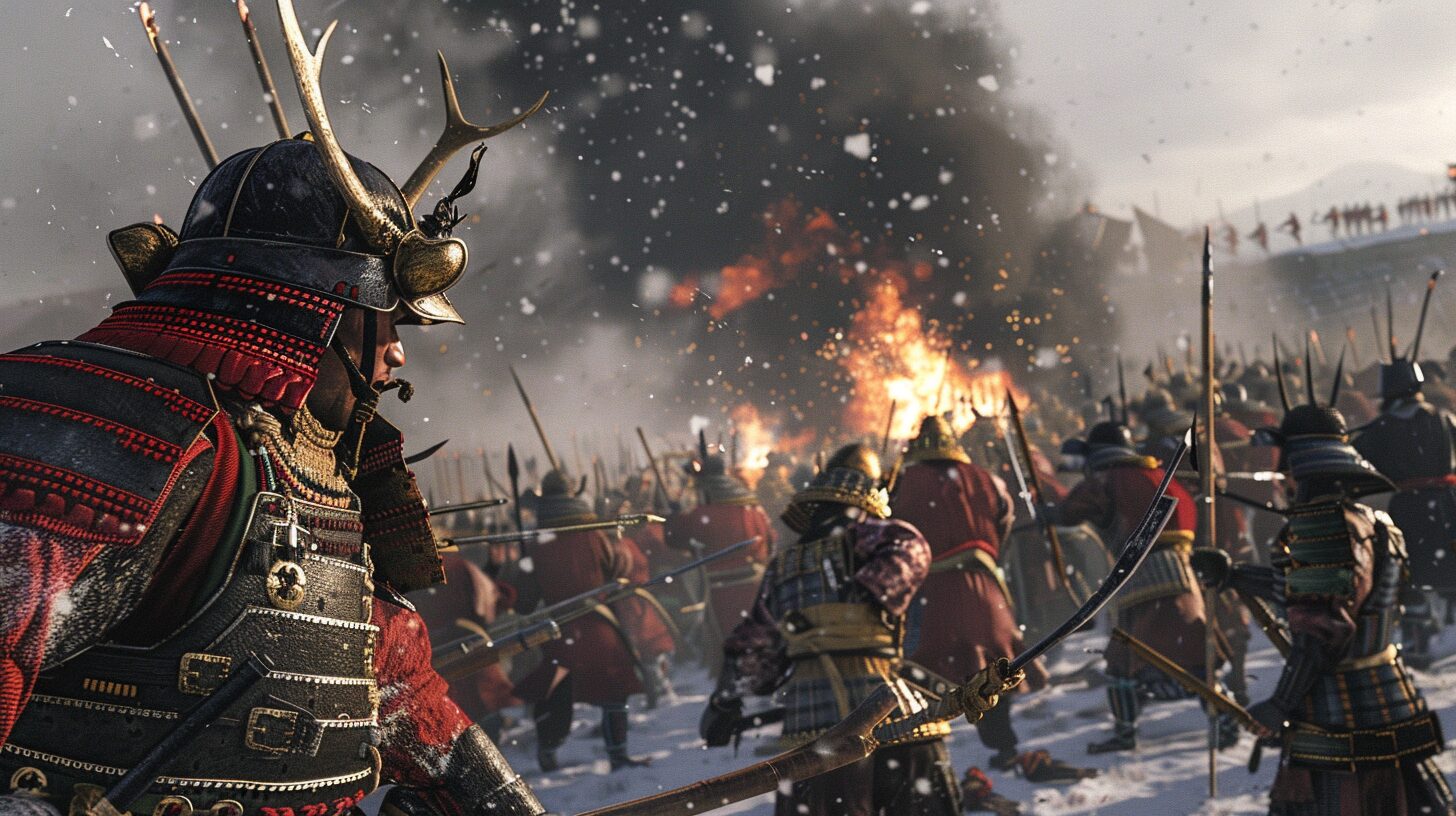
The Siege of Osaka — fought in two campaigns, the Winter Campaign of 1614 and the Summer Campaign of 1615 — was the final great battle of Japan’s Sengoku period. When the smoke cleared from the burning towers of Osaka Castle, the Toyotomi clan had been destroyed, the last possible rival to Tokugawa supremacy had been eliminated, and 265 years of enforced Tokugawa peace could begin. It was here that the legendary Sanada Yukimura earned his immortal reputation as “the bravest warrior in Japan.”
Final end of the Sengoku period; absolute Tokugawa supremacy established
Background to the Siege
The roots of the Siege of Osaka lie in the aftermath of Sekigahara (1600) and the death of Toyotomi Hideyoshi in 1598. Despite the Tokugawa victory at Sekigahara, the Toyotomi clan still possessed Osaka Castle — then the largest and most formidable fortress in Japan — and enormous wealth. Toyotomi Hideyori, Hideyoshi’s son, was young but surrounded by loyal retainers and rōnin (masterless samurai) who flocked to Osaka from across the country, men who had lost their positions after Sekigahara and had nothing to lose.
Tokugawa Ieyasu needed a pretext to destroy the Toyotomi. He found it in an inscription on a temple bell at Hōkōji in Kyoto, commissioned by the Toyotomi. The inscription read, in part: “May the state be peaceful and prosperous” (国家安康). Ieyasu’s scholars claimed this text cursed his name by splitting the characters of “家康” (Ieyasu). It was almost certainly a fabricated grievance — but it was enough. In the autumn of 1614, Ieyasu mobilized the largest army Japan had ever seen and marched on Osaka.
Course of the Siege
Scene 1 — The Winter Campaign: Osaka Under Siege
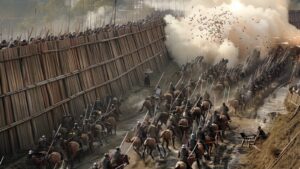
In November 1614, the massive Tokugawa army — nearly 200,000 strong — surrounded Osaka Castle. The castle’s natural defenses were formidable: wide moats, high stone walls, and a network of outer fortifications. The Toyotomi garrison, though heavily outnumbered, had one crucial advantage: the defenders of a siege can hold far longer than the attackers can sustain a siege. Waves of Tokugawa attacks against the outer defenses were repulsed.
Scene 2 — The Sanada Maru
Sanada Yukimura, one of the most brilliant tactical minds among the Toyotomi defenders, constructed an outwork south of the castle — a semi-circular earthwork fortification known as the Sanada Maru. When Tokugawa forces attacked it, they were met with withering defensive fire. The attacks on the Sanada Maru became one of the most costly engagements of the Winter Campaign, with the Tokugawa losing thousands of men in fruitless assaults. Yukimura’s fame spread across Japan.
Scene 3 — The Peace and the Fatal Compromise
Unable to storm the castle directly, Ieyasu deployed cannon — including large European-style guns — to bombard Osaka Castle from a distance. The psychological effect on the defenders, especially the women and non-combatants inside, was severe. In late December 1614, a peace agreement was negotiated. The terms seemed reasonable on paper: the Toyotomi would keep their lives and Osaka Castle. But hidden in the agreement was a devastating condition: the outer moats of Osaka Castle would be filled in. Once the truce was signed, Tokugawa engineers worked quickly — and soon the inner moats too were filled. Osaka Castle was stripped of its defenses.
Scene 4 — The Summer Campaign: The Final Reckoning
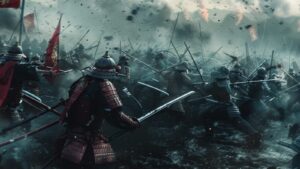
In the spring of 1615, with Osaka’s moats filled and its defenses compromised, Ieyasu found a new pretext and launched the Summer Campaign. The Toyotomi, unable to withstand a siege in a now-exposed castle, were forced to meet the Tokugawa in open battle. In a series of engagements culminating at Tennōji/Okayama on June 3, 1615, the Toyotomi army was destroyed in the field.
Scene 5 — Yukimura’s Last Charge and the Fall of Osaka Castle
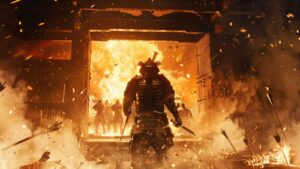
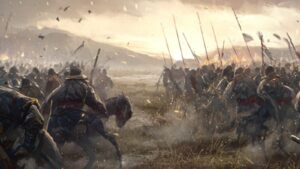
The last stand of the Summer Campaign produced the most legendary episode of the entire siege. Sanada Yukimura, at the head of a relatively small force, launched a ferocious assault directly at Ieyasu‘s command position. For a moment, the Tokugawa line buckled and Ieyasu’s headquarters was nearly overrun. By some accounts, Ieyasu prepared to commit suicide. But Yukimura had too few men to exploit the breakthrough. Exhausted and overwhelmed by sheer numbers, Yukimura was surrounded and killed. He reportedly died seated, accepting his end with composure. A Tokugawa soldier who killed him is said to have wept, so great was his respect for the fallen hero. Osaka Castle fell shortly after and burned. Toyotomi Hideyori and his mother Yodogimi committed suicide in the ruins.
Why the Siege of Osaka Changed History
The Siege of Osaka was the final chapter of the Sengoku period — the last moment when the Tokugawa dominance could theoretically have been overturned. With the Toyotomi destroyed, there was no longer any clan with the prestige, wealth, or military resources to challenge the Tokugawa. The Edo period — an era of centralized governance, enforced peace, and extraordinary cultural flowering — could now truly begin.
Sanada Yukimura became one of the great tragic heroes of Japanese history: a brilliant commander who fought with everything he had against overwhelming odds, almost — but not quite — changing the course of history in his final charge. He is remembered as “the bravest warrior in Japan” (日本一の兵), a phrase attributed to the Shimazu clan’s admiring assessment of his valor.
Participating Figures
Tokugawa Army
Tokugawa Ieyasu (徳川家康) — Commander-in-chief; the aging but ruthlessly effective shogun who eliminated the last threat to Tokugawa supremacy
Toyotomi Army
Sanada Yukimura (真田幸村) — The greatest hero of the Osaka defenders; builder of the Sanada Maru; led the final legendary charge at Ieyasu’s headquarters
Toyotomi Hideyoshi (豊臣秀吉) — Though Hideyoshi had died in 1598, it was his legacy — and his son Hideyori — that the Toyotomi loyalists fought to protect
Le Siège d’Osaka — mené en deux campagnes, la Campagne d’Hiver de 1614 et la Campagne d’Été de 1615 — fut la dernière grande bataille de la période Sengoku du Japon. Lorsque la fumée se dissipa des tours en flammes du château d’Osaka, le clan Toyotomi avait été détruit. C’est ici que le légendaire Sanada Yukimura mérita sa réputation immortelle de « guerrier le plus courageux du Japon ».
Fiche du Siège
Élément
Détails
Campagne d’Hiver
Novembre–Décembre 1614
Campagne d’Été
Mai–Juin 1615
Lieu
Château d’Osaka, province de Settsu (Osaka moderne)
Victoire totale des Tokugawa ; clan Toyotomi anéanti
Importance
Fin définitive de la période Sengoku ; suprématie absolue Tokugawa établie
Contexte du Siège
Les racines du Siège d’Osaka se trouvent dans les séquelles de Sekigahara (1600) et la mort de Toyotomi Hideyoshi en 1598. Malgré la victoire Tokugawa à Sekigahara, le clan Toyotomi possédait encore le château d’Osaka — alors la plus grande et formidable forteresse du Japon.
Tokugawa Ieyasu cherchait un prétexte pour détruire les Toyotomi. Il le trouva dans une inscription sur une cloche de temple à Kyoto. L’inscription fut interprétée comme portant malheur à son nom. C’était presque certainement un grief fabriqué — mais suffisant. À l’automne 1614, Ieyasu mobilisa la plus grande armée que le Japon eût jamais vue.
Déroulement du Siège
Scène 1 — La Campagne d’Hiver : Osaka Assiégée
En novembre 1614, la massive armée Tokugawa — près de 200 000 hommes — encercla le château d’Osaka. Les défenses naturelles étaient formidables : de larges douves, de hauts murs en pierre. Les vagues d’attaques Tokugawa contre les défenses extérieures furent repoussées.
Scène 2 — La Sanada Maru
Sanada Yukimura construisit un ouvrage avancé au sud du château — une fortification semi-circulaire connue sous le nom de Sanada Maru. Les attaques contre la Sanada Maru devinrent l’un des engagements les plus coûteux de la Campagne d’Hiver, les Tokugawa perdant des milliers d’hommes.
Scène 3 — La Paix et le Compromis Fatal
Ieyasu déploya des canons pour bombarder le château d’Osaka. Un accord de paix fut négocié fin décembre 1614. Les termes semblaient raisonnables : les Toyotomi garderaient leurs vies et le château. Mais cachée dans l’accord se trouvait une condition dévastatrice : les douves extérieures du château d’Osaka seraient comblées. Les ingénieurs Tokugawa travaillèrent rapidement — et bientôt les douves intérieures aussi furent comblées. Le château d’Osaka fut dépouillé de ses défenses.
Scène 4 — La Campagne d’Été : L’Ajustement Final
Au printemps 1615, Ieyasu lança la Campagne d’Été. Les Toyotomi, incapables de soutenir un siège dans un château maintenant exposé, furent contraints de rencontrer les Tokugawa en bataille ouverte. L’armée Toyotomi fut détruite en rase campagne.
Scène 5 — La Dernière Charge de Yukimura et la Chute d’Osaka
Sanada Yukimura lança un assaut féroce directement sur la position de commandement d’Ieyasu. Pour un moment, la ligne Tokugawa vacilla. Mais Yukimura n’avait pas assez d’hommes pour exploiter la percée. Il fut encerclé et tué. Le château d’Osaka tomba peu après et brûla. Toyotomi Hideyori et sa mère Yodogimi se suicidèrent dans les ruines.
Pourquoi le Siège d’Osaka a Changé l’Histoire
Le Siège d’Osaka fut le chapitre final de la période Sengoku. Avec les Toyotomi détruits, il n’y avait plus de clan possédant le prestige, la richesse ou les ressources militaires pour défier les Tokugawa. La période Edo — une ère de gouvernance centralisée, de paix imposée et d’extraordinaire épanouissement culturel — pouvait véritablement commencer.
Sanada Yukimura est devenu l’un des grands héros tragiques de l’histoire japonaise. Il est rappelé comme « le guerrier le plus courageux du Japon », une phrase attribuée à l’estimation admiratrice de son courage par le clan Shimazu.
Figures Participantes
Armée Tokugawa
Tokugawa Ieyasu (徳川家康) — Commandant en chef ; le shogun vieillissant mais implacablement efficace qui élimina la dernière menace à la suprématie Tokugawa
Armée Toyotomi
Sanada Yukimura (真田幸村) — Le plus grand héros des défenseurs d’Osaka ; constructeur de la Sanada Maru ; mena la dernière charge légendaire sur le quartier général d’Ieyasu
Toyotomi Hideyoshi (豊臣秀吉) — Bien qu’Hideyoshi fût mort en 1598, c’est son héritage — et son fils Hideyori — que les loyalistes Toyotomi combattirent pour protéger
Die Belagerung von Osaka: Der letzte Kampf der Toyotomi
Die Belagerung von Osaka — in zwei Feldzügen geführt, dem Winterfeldzug 1614 und dem Sommerfeldzug 1615 — war die letzte große Schlacht der Sengoku-Zeit Japans. Als der Rauch von den brennenden Türmen der Burg Osaka aufstieg, war der Toyotomi-Clan vernichtet. Hier erwarb sich der legendäre Sanada Yukimura seinen unsterblichen Ruf als „tapferster Krieger Japans”.
Endgültiges Ende der Sengoku-Zeit; absolute Tokugawa-Vorherrschaft etabliert
Hintergrund der Belagerung
Die Wurzeln der Belagerung von Osaka liegen in den Nachwirkungen von Sekigahara (1600) und dem Tod von Toyotomi Hideyoshi im Jahr 1598. Trotz des Tokugawa-Sieges bei Sekigahara besaß der Toyotomi-Clan noch immer Burg Osaka — damals die größte und beeindruckendste Festung Japans.
Tokugawa Ieyasu brauchte einen Vorwand, um die Toyotomi zu vernichten. Er fand ihn in einer Inschrift auf einer Tempelglocke in Kyoto. Die Inschrift soll Ieyasus Namen verflucht haben — fast sicher ein fabrizierter Vorwand. Im Herbst 1614 mobilisierte Ieyasu die größte Armee, die Japan je gesehen hatte.
Verlauf der Belagerung
Szene 1 — Der Winterfeldzug: Osaka unter Belagerung
Im November 1614 umzingelte die massive Tokugawa-Armee — fast 200.000 Mann stark — Burg Osaka. Die natürlichen Verteidigungsanlagen waren gewaltig. Wellen von Tokugawa-Angriffen gegen die äußeren Befestigungen wurden zurückgewiesen.
Szene 2 — Die Sanada Maru
Sanada Yukimura errichtete südlich der Burg einen Außenposten — eine halbkreisförmige Erdwerkbefestigung, bekannt als Sanada Maru. Die Angriffe auf die Sanada Maru wurden zu einem der kostspieligsten Gefechte des Winterfeldzugs. Yukimuras Ruhm verbreitete sich in ganz Japan.
Szene 3 — Der Frieden und der fatale Kompromiss
Ieyasu setzte Kanonen ein, um Burg Osaka zu beschießen. Ende Dezember 1614 wurde ein Friedensabkommen ausgehandelt. Verborgen in dem Abkommen war eine verheerende Bedingung: die äußeren Wassergräben der Burg Osaka würden aufgefüllt. Bald wurden auch die inneren Gräben aufgefüllt. Burg Osaka war ihrer Verteidigungsanlagen beraubt.
Szene 4 — Der Sommerfeldzug: Die endgültige Abrechnung
Im Frühjahr 1615 startete Ieyasu den Sommerfeldzug. Die Toyotomi, unfähig einer Belagerung in einer nun exponierten Burg standzuhalten, wurden gezwungen, die Tokugawa im offenen Kampf zu treffen. Die Toyotomi-Armee wurde in freiem Gelände vernichtet.
Szene 5 — Yukimuras letzter Angriff und der Fall von Osaka
Sanada Yukimura führte einen wilden Angriff direkt auf Ieyasus Kommandoposition. Die Tokugawa-Linie schwankte einen Moment. Aber Yukimura hatte zu wenig Männer, um den Durchbruch auszunutzen. Er wurde umzingelt und getötet. Die Burg Osaka fiel kurz danach und brannte. Toyotomi Hideyori und seine Mutter begingen Selbstmord in den Ruinen.
Warum die Belagerung von Osaka die Geschichte veränderte
Die Belagerung von Osaka war das letzte Kapitel der Sengoku-Zeit. Mit den zerstörten Toyotomi gab es keinen Clan mehr mit dem Prestige, dem Reichtum oder den militärischen Ressourcen, um die Tokugawa herauszufordern. Die Edo-Zeit — eine Ära der zentralisierten Regierung, des erzwungenen Friedens und außerordentlicher kultureller Blüte — konnte nun wirklich beginnen.
Sanada Yukimura wurde zu einem der großen tragischen Helden der japanischen Geschichte. Er wird als „tapferster Krieger Japans” erinnert — ein Titel, der dem Shimazu-Clan zugeschrieben wird.
Beteiligte Persönlichkeiten
Tokugawa-Armee
Tokugawa Ieyasu (徳川家康) — Oberbefehlshaber; der alternde, aber rücksichtslos effektive Shogun, der die letzte Bedrohung der Tokugawa-Vorherrschaft beseitigte
Toyotomi-Armee
Sanada Yukimura (真田幸村) — Der größte Held der Osaka-Verteidiger; Erbauer der Sanada Maru; führte den letzten legendären Angriff auf Ieyasus Hauptquartier
Toyotomi Hideyoshi (豊臣秀吉) — Obwohl Hideyoshi 1598 gestorben war, war es sein Vermächtnis — und sein Sohn Hideyori —, das die Toyotomi-Loyalisten zu schützen kämpften
Yanorisu
history fan
Nice to meet you! I am Yanorisu, a Japanese guy who loves history.


comment