The Battle of Nagashino (1575) stands as one of the most pivotal military engagements in Japanese history, marking the definitive transition from medieval samurai warfare to the age of modern tactics.
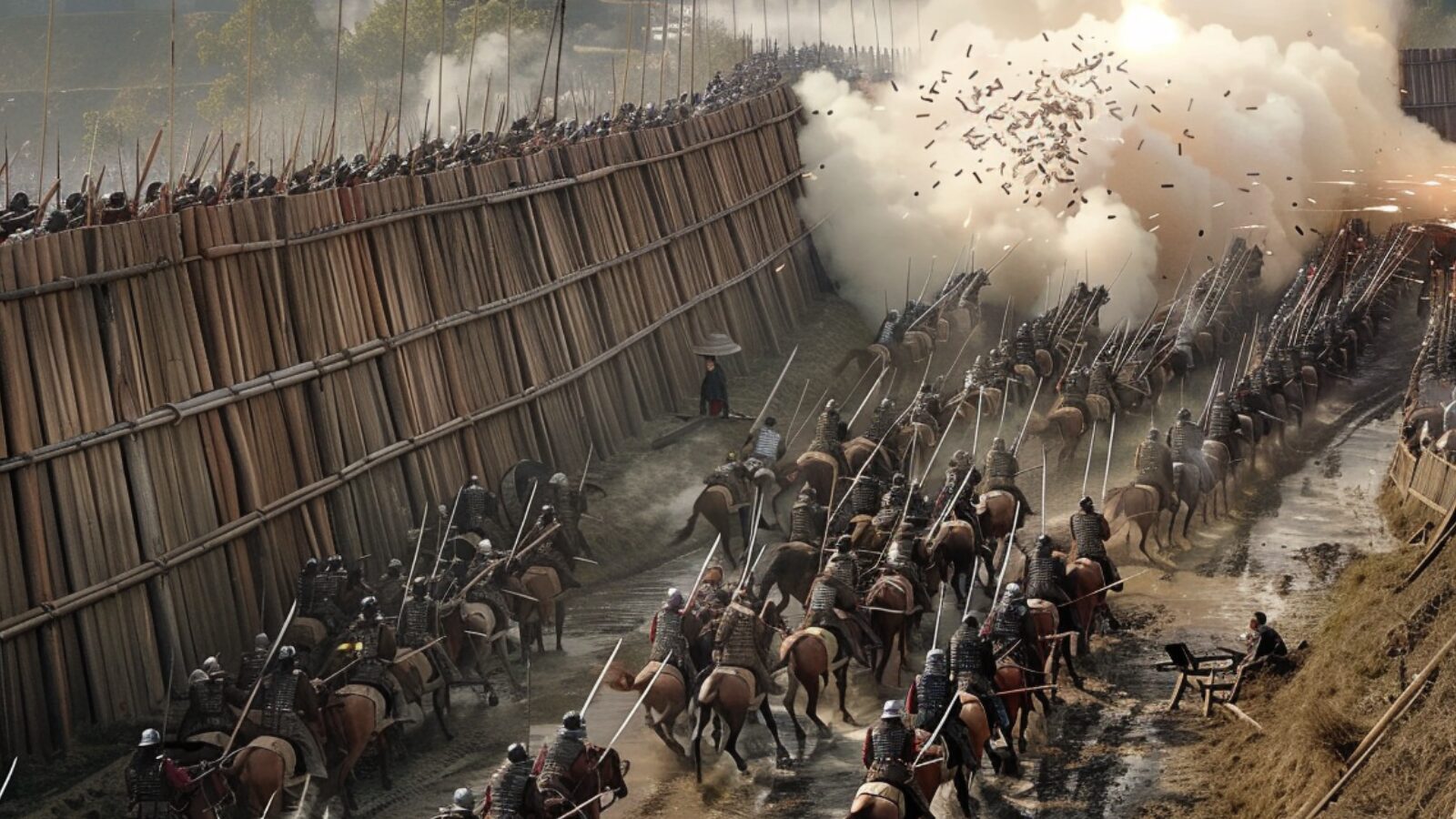
Fought on the plains of Shitaragahara, the battle pitted the aggressive Takeda Katsuyori—heir to the formidable Takeda Shingen—against the combined forces of Oda Nobunaga and Tokugawa Ieyasu. While the Takeda were feared for their elite, “invincible” cavalry, Nobunaga met them with a revolutionary response: a massive concentration of 3,000 arquebusiers protected by a long wooden palisade.
This article explores the strategic innovations that defined the battle, the heroic siege of Nagashino Castle, and the historical reality behind the legendary “three-volley” firing tactic. Discover how this clash of lead and steel reshaped the destiny of the Sengoku period forever.
Battle of Nagashino: The Dawn of Firearms Warfare in Japan
The Battle of Nagashino, fought on June 28, 1575, is one of the most celebrated and tactically significant engagements of the Sengoku period. On the fields of Shitaragahara in Mikawa Province, Oda Nobunaga and Tokugawa Ieyasu deployed an unprecedented mass volley of arquebuses to annihilate the legendary Takeda cavalry, permanently reshaping Japanese warfare.
Battle at a Glance
Item
Details
Date
June 28, 1575 (Tenshō 3, 5th month, 21st day)
Location
Shitaragahara, Mikawa Province (modern Shinshiro City, Aichi Prefecture)
Approx. 10,000 killed; nearly all senior commanders slain
Significance
Revolutionary mass-volley arquebus tactics; end of Takeda cavalry dominance
Background to the Battle
The death of the formidable Takeda Shingen in 1573 left his son Takeda Katsuyori with enormous shoes to fill. Far from retreating into caution, Katsuyori proved aggressive and ambitious. In the spring of 1575, he marched a powerful army of 15,000 into Mikawa Province and laid siege to Nagashino Castle, a strategic fortress held by Ieyasu‘s vassal Okudaira Sadamasa.
Nagashino Castle stood on a narrow peninsula formed by two rivers, making it nearly impossible to storm. Yet Katsuyori pressed the siege. Sadamasa dispatched a brave messenger — Torii Suneemon — who swam the rivers and slipped through enemy lines to reach Ieyasu and Nobunaga and beg for relief. (Torii was later caught and crucified by the Takeda, but not before signalling to the defenders that help was coming.)
Nobunaga responded decisively. He marched from Gifu with a massive relief force and, crucially, deployed 3,000 arquebusiers — the largest concentration of firearms ever assembled on a Japanese battlefield. On the plain of Shitaragahara, the allied army constructed a long wooden palisade and prepared an ambush of industrial scale.
Course of the Battle
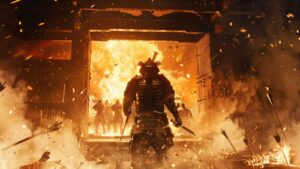
Scene 1 — The Siege of Nagashino Castle
Takeda Katsuyori had driven his army hard across the mountains of Shinano and Mikawa. His elite cavalry — the terror of the Sengoku period — had swept all before them. But Nagashino Castle refused to fall. Okudaira Sadamasa and his small garrison of roughly 500 men repulsed assault after assault across the rivers.
Scene 2 — The Wooden Palisade
Nobunaga‘s army arrived on June 27 and constructed a long wooden stockade across the Shitaragahara plain. Behind it, 3,000 arquebusiers were deployed in three rotating ranks — a formation designed to maintain near-continuous fire while one rank reloaded. Niwa Nagahide and other experienced commanders oversaw the disciplined deployment. Ieyasu‘s forces held the flanks.
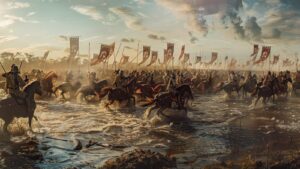
Scene 3 — The Takeda Cavalry Charge
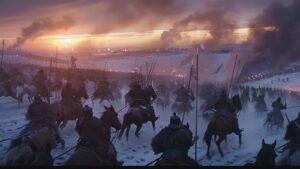
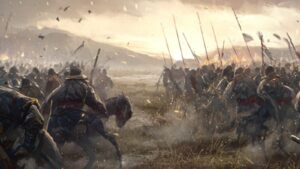
At dawn on June 28, Katsuyori launched his cavalry in repeated charges against the palisade. The Takeda horsemen were the finest in Japan — but the rotating arquebus volleys cut them down in waves. Charge after charge broke against the wooden fence in a storm of smoke and lead. Neither bravery nor horsemanship could overcome the mathematics of massed firearms.
Scene 4 — Death of the Takeda Generals
Wave after wave of Takeda charges were repulsed. In the carnage, the flower of the Takeda officer corps was annihilated. Baba Nobuharu, the legendary “Undefeated General” who had survived twenty-one campaigns without a scratch, was cut down fighting a rear-guard action to cover his lord’s retreat. Yamamoto Kansuke’s successor Yamagata Masakage also fell. Of the twenty-four generals Shingen had groomed as his “Twenty-Four Generals,” many perished at Nagashino.
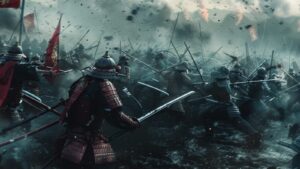
Scene 5 — Takeda Army Collapses
With their mounted warriors decimated and their senior officers dead, the Takeda army disintegrated. Katsuyori barely escaped with his life. The battle lasted only a few hours. The Oda–Tokugawa forces then swept forward, lifting the siege of Nagashino Castle. Katsuyori retreated to Kai, his clan’s power shattered beyond recovery.
Why Nagashino Changed History
Nagashino is often cited as the moment when medieval Japanese warfare ended and the age of modern military tactics began. Nobunaga‘s mass deployment of arquebuses demonstrated that disciplined firepower could defeat even the most celebrated cavalry force in the country. The Takeda clan never recovered; within seven years they were destroyed entirely.
Historical note: The famous “three-volley rotating formation” (三段撃ち) — in which arquebusiers fired in three rotating ranks for continuous fire — is one of the most celebrated elements of this battle in Japanese tradition. However, modern historians have found no contemporary primary sources confirming this specific tactic was used. Current scholarly consensus regards it as likely a later embellishment. What is certain is that Nobunaga concentrated an unprecedented number of firearms (estimates range from 1,000 to 3,000) behind a palisade, and this firepower proved decisive against the Takeda charges.
The battle also confirmed Nobunaga‘s genius for innovation. The lesson was not lost on his successors — Toyotomi Hideyoshi would take firearms even further, deploying them in the invasions of Korea.
Participating Figures
Oda–Tokugawa Alliance
Oda Nobunaga (織田信長) — Overall commander; mastermind of the rotating arquebus volley formation
Bataille de Nagashino : L’Aube des Armes à Feu dans la Guerre Japonaise
La bataille de Nagashino, livrée le 28 juin 1575, est l’une des batailles les plus célèbres de la période Sengoku. Sur les plaines de Shitaragahara dans la province de Mikawa, Oda Nobunaga et Tokugawa Ieyasu déployèrent un barrage de mousquets sans précédent pour anéantir la légendaire cavalerie Takeda, transformant définitivement l’art de la guerre japonais.
Fiche de la Bataille
Élément
Détails
Date
28 juin 1575 (Tenshō 3, 5e mois, 21e jour)
Lieu
Shitaragahara, province de Mikawa (ville de Shinshiro, préfecture d’Aichi)
Env. 10 000 tués ; presque tous les généraux supérieurs tués
Importance
Révolution tactique des arquebuses en salves ; fin de la suprématie de la cavalerie Takeda
Contexte de la Bataille
La mort du redoutable Takeda Shingen en 1573 laissa son fils Takeda Katsuyori face à un héritage immense. Loin de faire preuve de prudence, Katsuyori s’avéra agressif et ambitieux. Au printemps 1575, il marcha avec 15 000 hommes vers la province de Mikawa et assiégea le château de Nagashino, tenu par Okudaira Sadamasa, vassal d’Ieyasu.
Nobunaga répondit décisivement en marchant depuis Gifu avec une grande armée de secours, incluant 3 000 arquebusiers — la plus grande concentration d’armes à feu jamais assemblée sur un champ de bataille japonais. Sur la plaine de Shitaragahara, l’armée alliée construisit une longue palissade en bois et prépara une embuscade à grande échelle.
Déroulement de la Bataille
Scène 1 — Le Siège du Château de Nagashino
La cavalerie d’élite de Katsuyori avait tout balayé sur son passage. Mais le château de Nagashino résistait. Okudaira Sadamasa et sa garnison d’environ 500 hommes repoussèrent assaut après assaut.
Scène 2 — La Palissade en Bois
L’armée de Nobunaga arriva le 27 juin et construisit une longue palissade. Derrière elle, 3 000 arquebusiers furent déployés en trois rangs rotatifs — une formation conçue pour maintenir un feu quasi-continu pendant qu’un rang rechargeait. Niwa Nagahide supervisa le déploiement discipliné.
Scène 3 — La Charge de la Cavalerie Takeda
À l’aube du 28 juin, Katsuyori lança sa cavalerie en charges répétées contre la palissade. Les cavaliers Takeda étaient les meilleurs du Japon — mais les salves rotatives d’arquebuses les fauchèrent en vagues successives.
Scène 4 — La Mort des Généraux Takeda
Baba Nobuharu, le légendaire « Général Invaincu » qui avait survécu à vingt et une campagnes sans blessure, fut tué en couvrant la retraite de son seigneur. Yamagata Masakage tomba également.
Scène 5 — Effondrement de l’Armée Takeda
L’armée Takeda se désintégra. Katsuyori s’échappa de justesse. La bataille dura à peine quelques heures. Le siège de Nagashino fut levé, et la puissance du clan Takeda fut brisée au-delà de toute récupération.
Pourquoi Nagashino a Changé l’Histoire
Nagashino est souvent citée comme le moment où la guerre médiévale japonaise prit fin et où l’ère des tactiques militaires modernes commença. La concentration sans précédent d’arquebuses par Nobunaga derrière une palissade démontra que la puissance de feu pouvait vaincre même la plus célèbre force de cavalerie du pays. Le clan Takeda ne se remit jamais de cette défaite.
Note historique : La fameuse tactique des « salves en trois rangs rotatifs » (三段撃ち) est un élément emblématique de la tradition japonaise sur cette bataille. Cependant, les historiens modernes n’ont pas trouvé de sources primaires contemporaines confirmant cette formation spécifique, et le consensus actuel considère qu’il s’agit probablement d’un embellissement ultérieur. Ce qui est établi, c’est que Nobunaga concentra un nombre sans précédent d’arquebuses (entre 1 000 et 3 000 selon les estimations) derrière une palissade, et cette puissance de feu s’avéra décisive.
Figures Participantes
Alliance Oda–Tokugawa
Oda Nobunaga (織田信長) — Commandant en chef ; architecte de la formation de salves rotatives
Niwa Nagahide (丹羽長秀) — Général senior d’Oda ; organisa la défense de la palissade
Armée Takeda
Takeda Katsuyori (武田勝頼) — Commandant en chef ; fils de Takeda Shingen ; subit une défaite catastrophique
Baba Nobuharu (馬場信春) — Le légendaire « Général Invaincu » ; tué en couvrant la retraite de Katsuyori
Schlacht von Nagashino: Der Beginn des Feuerwaffenteitalters in Japan
Die Schlacht von Nagashino, die am 28. Juni 1575 stattfand, ist eine der bekanntesten Schlachten der Sengoku-Zeit. Auf den Feldern von Shitaragahara in der Provinz Mikawa setzten Oda Nobunaga und Tokugawa Ieyasu ein beispielloses Massenfeuer von Musketen ein, um die legendäre Takeda-Kavallerie zu vernichten und damit die japanische Kriegsführung dauerhaft zu verändern.
Schlachtdaten auf einen Blick
Punkt
Details
Datum
28. Juni 1575 (Tenshō 3, 5. Monat, 21. Tag)
Ort
Shitaragahara, Provinz Mikawa (heute Shinshiro, Präfektur Aichi)
Ca. 10.000 Gefallene; fast alle leitenden Kommandeure getötet
Bedeutung
Revolution des Maskenfeuervolley; Ende der Dominanz der Takeda-Kavallerie
Hintergrund der Schlacht
Der Tod des gewaltigen Takeda Shingen im Jahr 1573 hinterließ seinen Sohn Takeda Katsuyori vor einer immensen Aufgabe. Katsuyori erwies sich als aggressiv und ehrgeizig. Im Frühjahr 1575 marschierte er mit 15.000 Mann in die Provinz Mikawa und belagerte Burg Nagashino. Nobunaga antwortete entschlossen und entsandte ein gewaltiges Entsatzheer mit 3.000 Musketen — der größten jemals auf einem japanischen Schlachtfeld versammelten Feuerwaffenkonzentration.
Schlachtverlauf
Szene 1 — Die Belagerung von Burg Nagashino
Die Elite-Kavallerie von Katsuyori hatte alles vor sich hinweggefegt. Doch Burg Nagashino hielt stand. Okudaira Sadamasa und seine Garnison von rund 500 Mann schlugen Angriff für Angriff zurück.
Szene 2 — Der Holzpalisadenwall
Die Armee von Nobunaga traf am 27. Juni ein und errichtete eine lange Palisade. Dahinter wurden 3.000 Musketiere in drei rotierenden Reihen aufgestellt. Niwa Nagahide beaufsichtigte die disziplinierte Aufstellung.
Szene 3 — Der Angriff der Takeda-Kavallerie
Im Morgengrauen des 28. Juni ließ Katsuyori seine Kavallerie in wiederholten Angriffen gegen die Palisade vorgehen. Die rotierenden Musketenvolley mähten sie in Wellen nieder.
Szene 4 — Tod der Takeda-Generäle
Baba Nobuharu, der legendäre „Unbesiegte General”, der einundzwanzig Feldzüge ohne Kratzer überlebt hatte, fiel beim Deckungsrückzug für seinen Herrn. Viele der berühmten „Vierundzwanzig Generäle” Shingens fielen bei Nagashino.
Szene 5 — Zusammenbruch der Takeda-Armee
Katsuyori entkam mit knapper Not. Die Belagerung von Nagashino wurde aufgehoben, und die Macht des Takeda-Clans war unwiederbringlich zerbrochen.
Warum Nagashino die Geschichte veränderte
Nagashino wird oft als der Moment zitiert, in dem die mittelalterliche japanische Kriegsführung endete. Nobunagas beispiellose Konzentration von Feuerwaffen hinter einer Palisade bewies, dass massive Feuerkraft selbst die berühmteste Kavalleriemacht des Landes besiegen konnte. Der Takeda-Clan erholte sich nie mehr davon.
Historischer Hinweis: Die berühmte Taktik der „rotierenden Dreireihensalven” (三段撃ち) ist ein fester Bestandteil der japanischen historischen Überlieferung zu dieser Schlacht. Moderne Historiker haben jedoch keine zeitgenössischen Primärquellen gefunden, die diese spezifische Formation bestätigen. Der aktuelle wissenschaftliche Konsens betrachtet sie als wahrscheinlich nachträgliche Ausschmückung. Gesichert ist, dass Nobunaga eine beispiellose Anzahl von Musketen (Schätzungen zwischen 1.000 und 3.000) hinter einer Palisade konzentrierte und diese Feuerkraft entscheidend war.
Beteiligte Persönlichkeiten
Oda–Tokugawa-Allianz
Oda Nobunaga (織田信長) — Oberbefehlshaber; Architekt der rotierenden Musketenvolley-Formation

comment