On October 21, 1600, on the foggy plains of Sekigahara, over 170,000 samurai gathered for a battle that would end the era of chaos and birth a dynasty. This “Great Divide” pitted the Eastern Army under Tokugawa Ieyasu against the Western Army led by Ishida Mitsunari.
Though the Western Army held the tactical advantage on the heights, a single moment of betrayal by Kobayakawa Hideaki collapsed their lines in just six hours, forever shifting the course of Japanese history. This article dives into the political intrigue, the legendary commanders, and the strategic turning points that led to the establishment of the Tokugawa Shogunate and 265 years of peace.
Battle of Sekigahara: The Decisive Battle That Shaped the Edo Shogunate
The Battle of Sekigahara, fought on October 21, 1600, was one of the largest and most strategically pivotal battles in Japanese history. In a single day of intense combat on the plains of Sekigahara in Mino Province, Tokugawa Ieyasu‘s Eastern Army crushed the Western Army led by Ishida Mitsunari, opening the road to 265 years of Tokugawa rule.
Battle at a Glance
Item
Details
Date
October 21, 1600 (Keichō 5, 9th month, 15th day)
Location
Sekigahara, Mino Province (modern Gifu Prefecture)
The roots of Sekigahara lie in the death of the great unifier Toyotomi Hideyoshi in September 1598. Hideyoshi left behind only a young heir, Toyotomi Hideyori, and a council of five regents — among them Tokugawa Ieyasu — to govern in his name. Almost immediately, the regency council fractured.
On one side stood Tokugawa Ieyasu, the most powerful daimyo in eastern Japan, who began forging alliances and political marriages in defiance of the laws Hideyoshi had set. On the other stood Ishida Mitsunari, the sharp-minded administrator who had served Hideyoshi faithfully and now accused Ieyasu of treason. By 1600, Japan was effectively split into two factions: the Eastern Army loyal to Ieyasu and the Western Army committed to preserving the Toyotomi legacy.
While Ieyasu was occupied with the siege of Uesugi Kagekatsu in the northeast, Mitsunari raised the Western Army and marched. Ieyasu turned his forces around and rushed to meet them. Both sides converged on the narrow valley of Sekigahara, a natural chokepoint in Mino Province, in October 1600.
Course of the Battle
Scene 1 — Armies in the Fog (Early Morning)
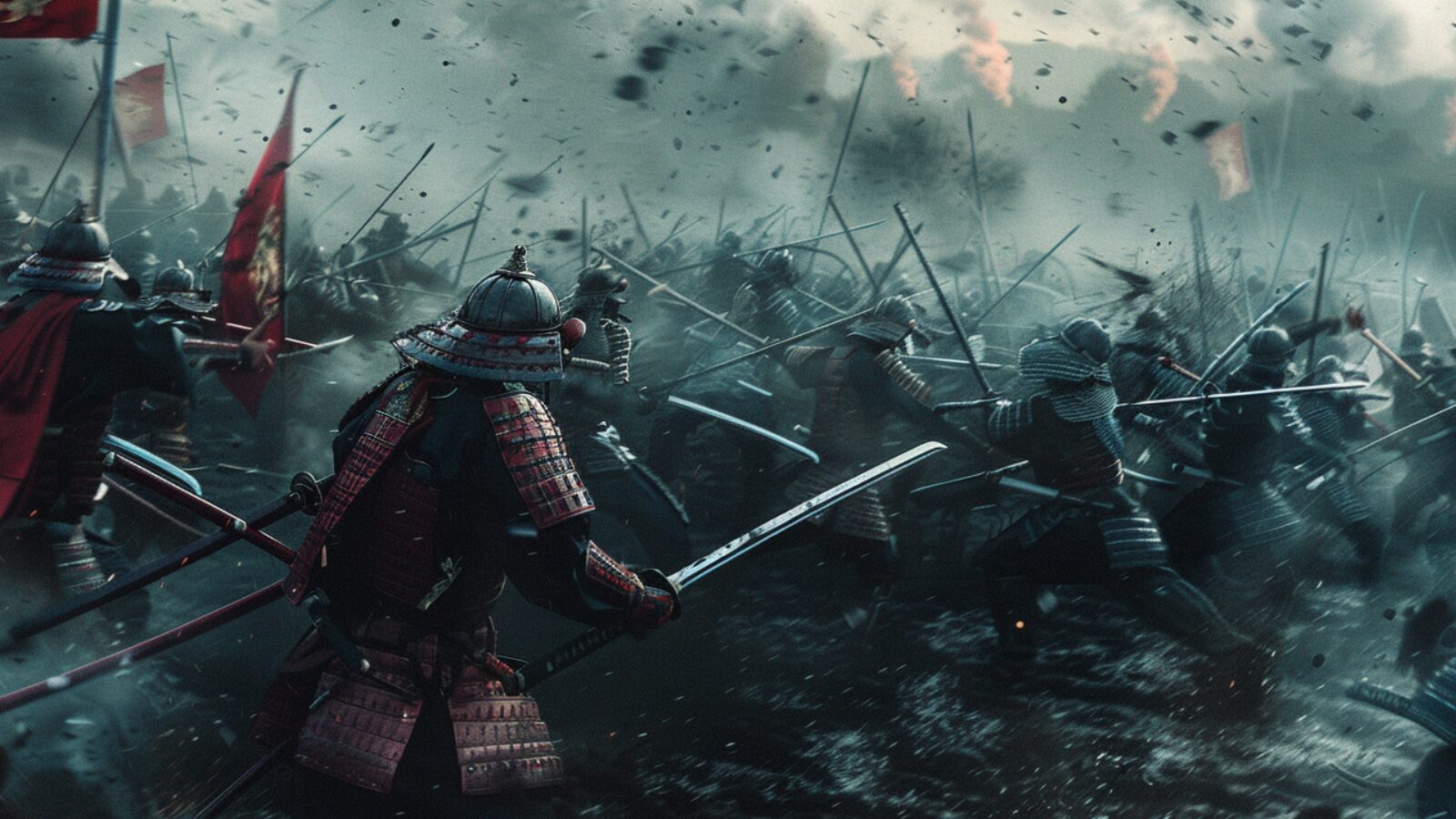
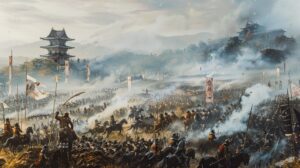
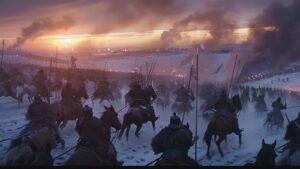
On the morning of October 21, a thick autumn fog blanketed the valley of Sekigahara. Roughly 170,000 warriors stood arrayed on both sides, unable to see far across the misty plain. The Western Army had the numerical advantage and held elevated positions on the surrounding hillsides — particularly Kobayakawa Hideaki‘s force of 15,000 on Mount Matsuo to the south. Tactically, the Western Army appeared to hold the stronger hand.
Scene 2 — The Battle Opens (Around 8 AM)
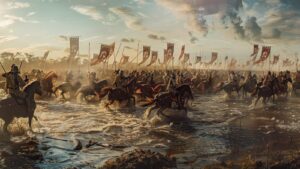
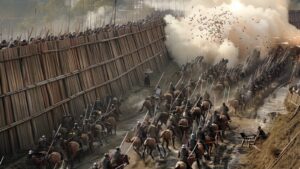
As the fog slowly lifted, Fukushima Masanori‘s Eastern vanguard clashed with the Western forces of Ueda Shigeyasu. The thunderous exchange of arquebus fire and the clash of spears spread rapidly along the line. Ieyasu advanced his golden war fan standard, signaling the full Eastern Army to engage.
Scene 3 — Bitter Fighting in the Center (Morning)
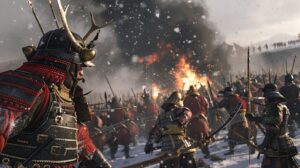
The main battle raged fiercely in the center of the valley. Fukushima Masanori and Ii Naomasa’s “Red Devils” hammered relentlessly at the Western line. Yet the Western forces held. Generals such as Shimazu Yoshihiro and Ukita Hideie fought with desperate tenacity. Meanwhile, several Western commanders on the hills — most critically Kobayakawa Hideaki — did not move, watching the struggle in silence.
Scene 4 — Kobayakawa’s Betrayal (Around 2 PM)
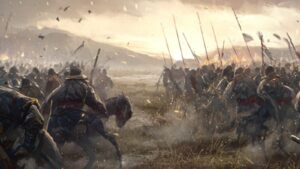
After hours of stalemate, Ieyasu reportedly had arquebuses fired toward Kobayakawa Hideaki‘s position on Mount Matsuo to force a decision. The shot was the signal. Kobayakawa charged down the mountain with 15,000 troops — but instead of striking the Eastern flank, he slammed into the rear of the Western Army’s Ōtani Yoshitsugu. Other Western commanders on the hills, seeing the betrayal, followed suit and turned on their former allies.
Scene 5 — Western Army Collapses (Afternoon)
Struck from front and rear simultaneously, the Western Army disintegrated within the hour. Ishida Mitsunari fled north, Ukita Hideie escaped into the mountains, and Shimazu Yoshihiro cut his way through the Eastern lines in a desperate fighting retreat. Within days, Mitsunari was captured, and on November 6 he was executed in Kyoto alongside other Western commanders. The battle had lasted barely six hours.
Why Sekigahara Changed History
Sekigahara was not merely a military victory — it was the political birth certificate of early modern Japan. Within three years, Tokugawa Ieyasu was appointed Seii Taishogun (Shogun) by the Emperor, formalizing a dynasty that would last until 1868. Hostile daimyo had their domains reduced or abolished; loyal ones were rewarded with new fiefs. The Toyotomi clan survived for another fifteen years but in a weakened state, finally extinguished at the Siege of Osaka in 1615.
In the long sweep of Japanese history, Sekigahara marks the definitive end of the Sengoku period’s chaos and the beginning of the Pax Tokugawa — two and a half centuries of enforced peace during which Japan’s culture, arts, and economy flourished.
Participating Figures
Eastern Army
Tokugawa Ieyasu (徳川家康) — Commander-in-chief of the Eastern Army; founding Shogun of the Edo period
Fukushima Masanori (福島正則) — Eastern vanguard commander; fierce warrior and Toyotomi loyalist who switched to Ieyasu
Date Masamune (伊達政宗) — “One-Eyed Dragon” of Mutsu; supported the Eastern Army in the northeast
Kobayakawa Hideaki (小早川秀秋) — Originally a Western general; his defection to the Eastern side was the turning point of the battle
Western Army
Ishida Mitsunari (石田三成) — Western Army mastermind; brilliant administrator and devoted Toyotomi loyalist
Bataille de Sekigahara : Le Tournant Décisif de l’Histoire du Japon
La bataille de Sekigahara, livrée le 21 octobre 1600, est l’une des batailles les plus importantes et les plus décisives de l’histoire japonaise. En une seule journée de combat acharné dans la plaine de Sekigahara, l’Armée de l’Est commandée par Tokugawa Ieyasu écrasa l’Armée de l’Ouest dirigée par Ishida Mitsunari, ouvrant la voie à deux cent soixante-cinq ans de domination Tokugawa.
Fiche de la Bataille
Élément
Détails
Date
21 octobre 1600 (15e jour du 9e mois de Keichō 5)
Lieu
Sekigahara, province de Mino (préfecture de Gifu actuelle)
La bataille de Sekigahara trouve son origine dans la mort du grand unificateur Toyotomi Hideyoshi en septembre 1598. Hideyoshi laissait derrière lui un jeune héritier, Toyotomi Hideyori, et un conseil de cinq régents pour gouverner en son nom. Parmi eux se trouvait Tokugawa Ieyasu, le daimyo le plus puissant du Japon oriental.
Ieyasu entreprit rapidement de nouer des alliances et des mariages politiques en violation des lois établies par Hideyoshi. Face à lui, Ishida Mitsunari, administrateur brillant qui avait loyalement servi Hideyoshi, accusa Ieyasu de trahison. En 1600, le Japon se trouvait effectivement divisé en deux factions : l’Armée de l’Est fidèle à Ieyasu et l’Armée de l’Ouest déterminée à préserver l’héritage des Toyotomi.
Déroulement de la Bataille
Scène 1 — Les Armées dans le Brouillard
Au matin du 21 octobre, un épais brouillard automnal enveloppait la vallée de Sekigahara. Environ 170 000 guerriers se faisaient face, incapables de se voir à travers la brume. L’Armée de l’Ouest, notamment la force de Kobayakawa Hideaki sur le mont Matsuo, semblait détenir l’avantage tactique.
Scène 2 — L’Ouverture du Combat (vers 8h)
Lorsque le brouillard commença à se lever, l’avant-garde de Fukushima Masanori entra en collision avec les forces occidentales. Le tonnerre des arquebuses et le fracas des lances se répandirent rapidement sur toute la ligne. Ieyasu fit avancer son étendard en éventail doré, signalant l’engagement général.
Scène 3 — Combats Acharnés au Centre
La bataille centrale fut féroce. Fukushima Masanori et les « Diables Rouges » d’Ii Naomasa martelèrent sans relâche la ligne occidentale. Shimazu Yoshihiro et Ukita Hideie combattirent avec une ténacité désespérée. Kobayakawa Hideaki, sur les hauteurs, restait immobile dans un silence inquiétant.
Scène 4 — La Trahison de Kobayakawa (vers 14h)
Après des heures d’impasse, Ieyasu aurait fait tirer des arquebuses vers la position de Kobayakawa Hideaki sur le mont Matsuo pour le forcer à choisir son camp. Kobayakawa chargea alors avec 15 000 hommes — non pas contre le flanc oriental, mais dans le dos de l’Armée de l’Ouest.
Scène 5 — L’Effondrement de l’Armée de l’Ouest
Frappée de front et de dos simultanément, l’Armée de l’Ouest se désintégra en moins d’une heure. Ishida Mitsunari prit la fuite vers le nord, fut capturé quelques jours plus tard et exécuté à Kyoto le 6 novembre.
Pourquoi Sekigahara a Changé l’Histoire
Sekigahara ne fut pas seulement une victoire militaire : ce fut l’acte de naissance politique du Japon prémoderne. En 1603, Tokugawa Ieyasu fut nommé Seii Taishōgun, fondant une dynastie qui dura jusqu’en 1868. La famille Toyotomi survécut encore quinze ans avant d’être définitivement éteinte lors du Siège d’Osaka en 1615. Sekigahara marque la fin définitive de la période Sengoku et le début de la Pax Tokugawa — deux siècles et demi de paix imposée au cours desquels la culture, les arts et l’économie japonaises s’épanouirent.
Figures Participantes
Armée de l’Est
Tokugawa Ieyasu (徳川家康) — Commandant en chef de l’Armée de l’Est ; fondateur du shogunat d’Edo
Schlacht von Sekigahara: Die Entscheidungsschlacht, die das Edo-Shogunat begründete
Die Schlacht von Sekigahara, die am 21. Oktober 1600 stattfand, war eine der größten und strategisch bedeutsamsten Schlachten in der japanischen Geschichte. In einem einzigen Tag intensiver Kämpfe auf der Ebene von Sekigahara besiegte die Ostarmee unter Tokugawa Ieyasu die Westarmee unter Ishida Mitsunari und ebnete den Weg für 265 Jahre Tokugawa-Herrschaft.
Die Wurzeln von Sekigahara liegen im Tod des großen Einers Toyotomi Hideyoshi im September 1598. Hideyoshi hinterließ einen jungen Erben, Toyotomi Hideyori, und einen Rat von fünf Regenten. Darunter befand sich Tokugawa Ieyasu, der mächtigste Daimyo Ostjapans, der sogleich begann, politische Bündnisse zu schmieden und damit die von Hideyoshi erlassenen Gesetze zu verletzen.
Ishida Mitsunari, der scharfsinnige Verwaltungsbeamte, der Hideyoshi treu gedient hatte, warf Ieyasu Verrat vor. Bis 1600 war Japan faktisch in zwei Fraktionen gespalten: die Ostarmee, die Ieyasu loyal war, und die Westarmee, die das Erbe der Toyotomi bewahren wollte.
Schlachtverlauf
Szene 1 — Heere im Nebel
Am Morgen des 21. Oktober lag dichter Herbstnebel über dem Tal von Sekigahara. Rund 170.000 Krieger standen sich gegenüber. Die Westarmee hielt taktisch günstigere Positionen, insbesondere Kobayakawa Hideaki mit 15.000 Mann auf dem Berg Matsuo.
Szene 2 — Beginn der Schlacht (ca. 8 Uhr)
Als der Nebel sich lichtete, prallte die Vorhut unter Fukushima Masanori auf die Westkräfte. Das Donnern der Musketen und das Klirren der Speere breitete sich rasch entlang der gesamten Linie aus.
Szene 3 — Erbitterte Kämpfe im Zentrum
Fukushima Masanori und die „Roten Teufel” des Ii Naomasa hämmerten unaufhörlich auf die Westlinie ein. Shimazu Yoshihiro und Ukita Hideie widerstanden verbissen. Kobayakawa Hideaki auf den Höhen blieb scheinbar unentschlossen.
Szene 4 — Kobayakawas Verrat (ca. 14 Uhr)
Nach stundenlangem Patt ließ Ieyasu Musketenschüsse auf Kobayakawa Hideakis Stellung abfeuern, um eine Entscheidung zu erzwingen. Kobayakawa stürmte mit 15.000 Mann den Berg hinunter — und traf die Westarmee von hinten.
Szene 5 — Zusammenbruch der Westarmee
Gleichzeitig von vorn und hinten angegriffen, zerfiel die Westarmee innerhalb einer Stunde. Ishida Mitsunari floh nach Norden, wurde wenige Tage später gefangen und am 6. November in Kyoto hingerichtet.
Warum Sekigahara die Geschichte veränderte
Sekigahara war nicht nur ein militärischer Sieg — es war die politische Geburtsurkunde des frühneuzeitlichen Japans. 1603 wurde Tokugawa Ieyasu zum Seii Taishōgun ernannt und gründete eine Dynastie, die bis 1868 Bestand haben sollte. Das Clan der Toyotomi überlebte noch fünfzehn Jahre, bevor es 1615 bei der Belagerung von Osaka endgültig ausgelöscht wurde. Sekigahara markiert das definitive Ende der Sengoku-Zeit und den Beginn der Pax Tokugawa.
comment