Battle of Kawanakajima: The Greatest Rivalry of the Sengoku Age
The Battles of Kawanakajima were a series of five military engagements fought between 1553 and 1564 on the alluvial plains of Shinano Province. They pitted two of the most celebrated warlords of the Sengoku period against each other: Takeda Shingen, “The Tiger of Kai,” and Uesugi Kenshin, “The Dragon of Echigo.” The Fourth Battle, fought on September 10, 1561, was by far the most intense and is the engagement most people refer to when speaking of Kawanakajima.
Battle at a Glance (Fourth Battle, 1561)
Item
Details
Date
September 10, 1561 (Eiroku 4, 8th month, 29th day)
Location
Hachimanbara, Kawanakajima, Shinano Province (modern Nagano City, Nagano Prefecture)
The most dramatic clash of the two greatest rival warlords; a symbol of samurai honor
Background to the Battle
The conflict over Kawanakajima — the broad plain between the Chikuma and Saigawa rivers in central Shinano — grew from the ambitions of both men to control Shinano Province. Takeda Shingen had been systematically conquering Shinano throughout the 1540s and 1550s, pushing northward. As he did so, displaced Shinano warlords appealed for help to Uesugi Kenshin of Echigo, the powerful province to the north.
Kenshin was a deeply religious man — devoted to the god Bishamonten, deity of war and justice — and he viewed Shingen’s territorial expansion as something that had to be stopped, not merely out of self-interest but out of a sense of duty. The two men thus came to represent not just rival powers but rival visions of what a warlord should be: Shingen the calculating strategist, Kenshin the principled warrior.
The first three battles (1553, 1555, 1557) were largely inconclusive skirmishes. But by 1561, Shingen had built Kaizu Castle (modern Matsushiro) as a forward base on the plain, threatening to permanently seize Kawanakajima. Kenshin resolved to destroy it.
Course of the Battle (Fourth Battle)
Scene 1 — The Woodpecker Strategy
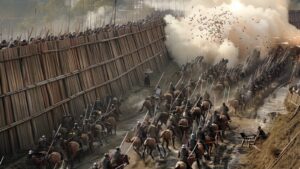
Shingen‘s chief strategist, Yamamoto Kansuke, devised what became known as the “Woodpecker Tactic” (Kitsutsuki Senpō). The plan: send 12,000 troops by night to assault Kenshin‘s camp on Mount Tsurugawa (Saijoyama), driving him down onto the plain — where the main Takeda army of 8,000 would be waiting at Hachimanbara to destroy him. It was a classic hammer-and-anvil operation.
Scene 2 — Kenshin Reads the Plan
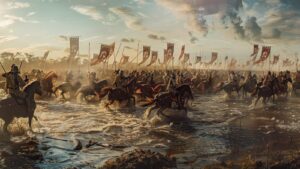
Kenshin appears to have deduced the Woodpecker strategy. During the night of September 9–10, he quietly led his entire army down from Saijoyama and crossed the Chikuma River in darkness. By dawn on September 10, the Uesugi army stood in full battle formation on Hachimanbara — exactly where Shingen had intended to annihilate the fleeing remnants of Kenshin’s force. Instead, it was the main Takeda army that now faced the full Uesugi force in a surprise assault it had never anticipated.
Scene 3 — Chaos in the Morning Fog
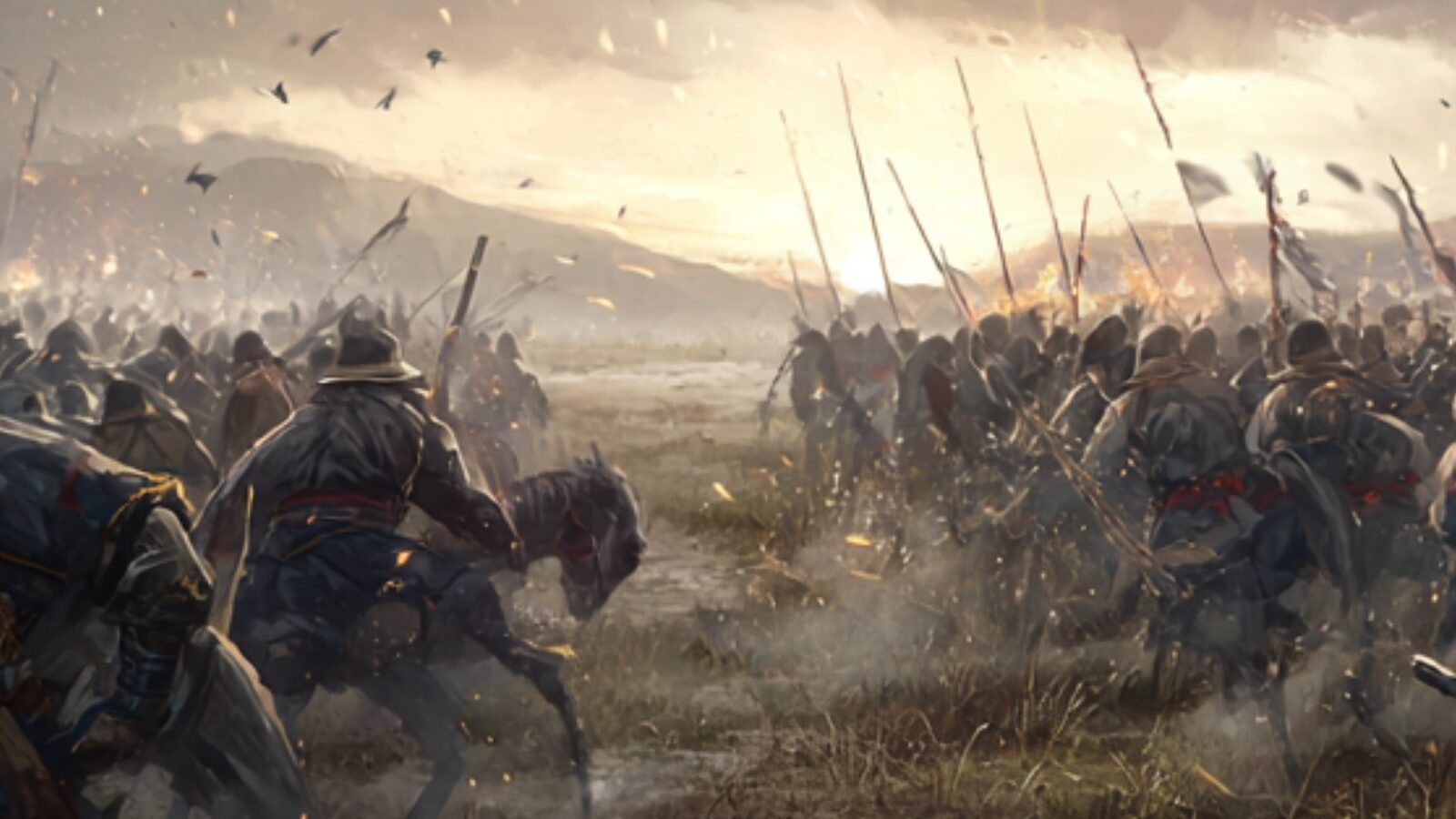
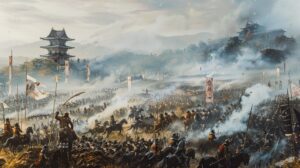
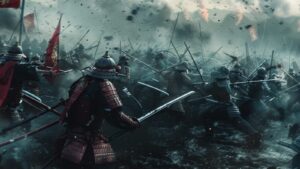
A heavy morning mist shrouded the plain of Hachimanbara. When the fog lifted, Shingen and his bodyguard found themselves face to face with the entire Uesugi army. The Uesugi charged. The Takeda command post was struck with terrifying force. Shingen reportedly defended himself personally with his war-fan as Kenshin himself — according to legend — rode to the Takeda headquarters and attacked Shingen directly, cutting at him with his sword three times before being driven off by Takeda spearmen.
Scene 4 — Yamamoto Kansuke’s Final Charge
Yamamoto Kansuke, realizing that his Woodpecker Strategy had failed and that his plan had led his lord into crisis, reportedly took personal responsibility. He plunged alone into the Uesugi lines, fighting until he had been struck by eighty wounds. He died on the field of Hachimanbara. The loss of the Takeda’s greatest strategist, combined with the death of Shingen’s beloved younger brother Takeda Nobushige, made the Fourth Battle an especially bitter affair for the Takeda clan.
Scene 5 — The Arrival of the Second Force and Withdrawal
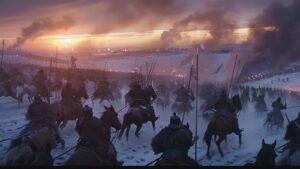
The battle hung in the balance for hours as both sides fought with desperate ferocity. By midday, the Takeda detachment that had gone to assault Saijoyama — finding it empty — returned to the plain and struck the Uesugi rear. Caught between two forces, Kenshin ordered a fighting withdrawal across the Chikuma River. Both sides had suffered enormously. Neither had destroyed the other. Kawanakajima remained contested territory.
Why Kawanakajima Changed History
In strict military terms, the Fourth Battle of Kawanakajima was indecisive — neither Shingen nor Kenshin achieved their strategic objectives. Yet its significance far exceeds its tactical outcome. The battle became the supreme symbol of samurai rivalry and personal honor, the clash of two irresistible forces who respected each other even as they tried to destroy each other.
There is a famous episode — possibly legendary, but deeply embedded in Japanese culture — of Kenshin sending a gift of salt to Shingen when Shingen’s provinces were blockaded by enemies who withheld salt supplies. “I do not fight with salt, but with swords,” Kenshin is said to have declared. Whether historical fact or myth, the story captures the essence of the Kawanakajima rivalry: two men defined by honor as much as by ambition.
Participating Figures
Takeda Army
Takeda Shingen (武田信玄) — Commander-in-chief; the “Tiger of Kai”; reputedly defended himself with his war-fan when Kenshin charged his headquarters
Yamamoto Kansuke (山本勘助) — Takeda’s master strategist; devised the Woodpecker Tactic; died in a suicidal charge after his plan failed
Uesugi Army
Uesugi Kenshin (上杉謙信) — Commander-in-chief; the “Dragon of Echigo”; renowned as one of the greatest military commanders of the Sengoku period
Bataille de Kawanakajima : La Plus Grande Rivalité de l’Ère Sengoku
Les batailles de Kawanakajima furent une série de cinq engagements militaires entre 1553 et 1564 dans la province de Shinano. Elles opposèrent deux des seigneurs de guerre les plus célèbres de la période Sengoku : Takeda Shingen, « Le Tigre de Kai », et Uesugi Kenshin, « Le Dragon d’Echigo ». La Quatrième Bataille, livrée le 10 septembre 1561, fut de loin la plus intense.
Fiche de la Bataille (Quatrième Bataille, 1561)
Élément
Détails
Date
10 septembre 1561 (Eiroku 4, 8e mois, 29e jour)
Lieu
Hachimanbara, Kawanakajima, province de Shinano (ville de Nagano actuelle)
Non décisif — les deux camps subirent de lourdes pertes
Morts notables
Yamamoto Kansuke (Takeda), Takeda Nobushige (frère de Shingen)
Importance
Le choc le plus dramatique des deux plus grands rivaux ; symbole de l’honneur samouraï
Contexte de la Bataille
Le conflit pour Kawanakajima — la vaste plaine entre les rivières Chikuma et Saigawa dans le centre de Shinano — naquit des ambitions des deux hommes à contrôler la province de Shinano. Takeda Shingen avait systématiquement conquis Shinano tout au long des années 1540 et 1550. Les seigneurs déplacés firent appel à Uesugi Kenshin d’Echigo.
Kenshin était un homme profondément religieux, dévoué au dieu Bishamonten. Il considérait l’expansion territoriale de Shingen comme quelque chose qui devait être arrêté — non par intérêt personnel, mais par sens du devoir. Les deux hommes représentaient ainsi deux visions différentes de ce que devait être un seigneur de guerre.
Déroulement de la Bataille (Quatrième Bataille)
Scène 1 — La Stratégie du Pivert
Le grand stratège de Shingen, Yamamoto Kansuke, conçut la « Tactique du Pivert » : envoyer 12 000 hommes de nuit pour attaquer le camp de Kenshin sur le mont Tsurugawa, le forçant à descendre dans la plaine — où l’armée principale Takeda l’attendrait pour le détruire.
Scène 2 — Kenshin Déjoue le Plan
Kenshin semble avoir deviné la stratégie du Pivert. Dans la nuit du 9 au 10 septembre, il guida discrètement toute son armée vers le bas et traversa la rivière Chikuma. À l’aube, l’armée Uesugi se trouvait en formation de bataille complète à Hachimanbara — exactement là où Shingen attendait d’anéantir les restes en fuite de la force de Kenshin.
Scène 3 — Chaos dans le Brouillard Matinal
Un épais brouillard matinal enveloppait la plaine. Quand il se leva, Shingen et sa garde du corps se retrouvèrent face à toute l’armée Uesugi. Selon la légende, Kenshin lui-même galopa jusqu’au quartier général de Takeda et attaqua Shingen directement, portant trois coups d’épée avant d’être repoussé par les lanciers Takeda.
Scène 4 — La Dernière Charge de Yamamoto Kansuke
Yamamoto Kansuke, réalisant que sa stratégie avait échoué, prit personnellement la responsabilité. Il plongea seul dans les lignes Uesugi et combattit jusqu’à recevoir quatre-vingts blessures. Il mourut sur le champ de Hachimanbara.
Scène 5 — L’Arrivée de la Deuxième Force et le Retrait
La bataille se balança pendant des heures. Au milieu de la journée, le détachement Takeda qui avait attaqué le mont Saijoyama — ne trouvant personne — revint dans la plaine et frappa l’arrière Uesugi. Kenshin ordonna un retrait combattant à travers la rivière Chikuma.
Pourquoi Kawanakajima a Changé l’Histoire
Du point de vue strictement militaire, la Quatrième Bataille fut indécise. Pourtant, sa signification dépasse largement son issue tactique. La bataille devint le symbole suprême de la rivalité samouraï et de l’honneur personnel. Il existe un épisode célèbre — peut-être légendaire — de Kenshin envoyant du sel à Shingen quand ses provinces étaient bloquées. « Je ne combats pas avec le sel, mais avec des épées », dit-on que Kenshin déclara. Que ce soit un fait historique ou un mythe, l’histoire capture l’essence de la rivalité de Kawanakajima.
Yamamoto Kansuke (山本勘助) — Maître stratège des Takeda ; mourut dans une charge suicidaire après l’échec de son plan
Armée Uesugi
Uesugi Kenshin (上杉謙信) — Commandant en chef; le « Dragon d’Echigo »; l’un des plus grands commandants militaires de la période Sengoku
Schlacht von Kawanakajima: Die Größte Rivalität der Sengoku-Zeit
Die Schlachten von Kawanakajima waren eine Reihe von fünf militärischen Auseinandersetzungen zwischen 1553 und 1564 in der Provinz Shinano. Sie stellten zwei der berühmtesten Kriegsherren der Sengoku-Zeit gegeneinander: Takeda Shingen, den „Tiger von Kai”, und Uesugi Kenshin, den „Drachen von Echigo”. Die Vierte Schlacht vom 10. September 1561 war bei weitem die intensivste.
Schlachtdaten auf einen Blick (Vierte Schlacht, 1561)
Punkt
Details
Datum
10. September 1561 (Eiroku 4, 8. Monat, 29. Tag)
Ort
Hachimanbara, Kawanakajima, Provinz Shinano (heute Stadt Nagano)
Der dramatischste Zusammenstoß der beiden größten Rivalen; Symbol der Samurai-Ehre
Hintergrund der Schlacht
Der Konflikt um Kawanakajima — die breite Ebene zwischen den Flüssen Chikuma und Saigawa — erwuchs aus den Ambitionen beider Männer, die Provinz Shinano zu kontrollieren. Takeda Shingen hatte Shinano in den 1540er und 1550er Jahren systematisch erobert. Die vertriebenen Shinano-Herren wandten sich an Uesugi Kenshin.
Kenshin war ein tief religiöser Mann und betrachtete Shingens Expansion als etwas, das gestoppt werden musste — nicht nur aus Eigeninteresse, sondern aus Pflichtgefühl. Die beiden Männer repräsentierten damit nicht nur rivalisierende Mächte, sondern rivalisierende Visionen davon, was ein Kriegsherr sein sollte.
Schlachtverlauf (Vierte Schlacht)
Szene 1 — Die Specht-Strategie
Der Chefstratege von Shingen, Yamamoto Kansuke, entwarf die „Specht-Taktik”: 12.000 Mann sollten nachts das Lager von Kenshin auf dem Berg Tsurugawa angreifen und ihn in die Ebene treiben — wo die Hauptmacht Shingens wartete, um ihn zu vernichten.
Szene 2 — Kenshin Durchschaut den Plan
Kenshin scheint die Specht-Strategie durchschaut zu haben. In der Nacht vom 9. auf den 10. September führte er seine gesamte Armee lautlos von Berg Tsurugawa herunter und überquerte den Chikuma-Fluss im Dunkeln. Bei Tagesanbruch stand die Uesugi-Armee in voller Schlachtaufstellung auf Hachimanbara.
Szene 3 — Chaos im Morgennebel
Dichter Morgennebel hüllte die Ebene ein. Als er sich lichtete, fanden sich Shingen und seine Leibwache der gesamten Uesugi-Armee gegenüber. Der Legende nach ritt Kenshin selbst zum Takeda-Hauptquartier und griff Shingen direkt an, wobei er dreimal mit seinem Schwert zuschlug, bevor er von Takeda-Speerkämpfern zurückgedrängt wurde.
Szene 4 — Der letzte Angriff von Yamamoto Kansuke
Yamamoto Kansuke, der erkannte, dass sein Plan gescheitert war, übernahm persönlich die Verantwortung. Er stürmte allein in die Uesugi-Linien und kämpfte, bis er achtzig Wunden erhalten hatte. Er starb auf dem Feld von Hachimanbara.
Szene 5 — Ankunft der zweiten Kraft und Rückzug
Die Takeda-Abteilung, die Berg Saijoyama angegriffen hatte — ihn leer vorfindend —, kehrte in die Ebene zurück und traf den Uesugi-Rücken. Kenshin ordnete einen kämpfenden Rückzug über den Chikuma-Fluss an. Beide Seiten hatten enorm gelitten. Kawanakajima blieb umstrittenes Gebiet.
Warum Kawanakajima die Geschichte veränderte
Die Vierte Schlacht war militärisch unentschieden. Dennoch übersteigt ihre Bedeutung bei weitem ihr taktisches Ergebnis. Die Schlacht wurde zum höchsten Symbol der Samurai-Rivalität und der persönlichen Ehre. Es gibt eine berühmte Episode — möglicherweise legendär — von Kenshin, der Shingen Salz schickte, als seine Provinzen blockiert wurden. „Ich kämpfe nicht mit Salz, sondern mit Schwertern”, soll Kenshin erklärt haben. Ob historische Tatsache oder Mythos — die Geschichte erfasst das Wesen der Kawanakajima-Rivalität.
comment